
Weibo Login
# Documentation
This document explains how to integrate the Weibo authorization login function in an Android client. Weibo login usage scenario: The Weibo APP is already installed on the user's phone. The user clicks the Weibo login button on the client APP. The IDaaS SDK launches the authorization page within the Weibo APP. After the user clicks the "Authorize Login" button and authorization is successful, the Weibo APP redirects back to the client APP. At this point, the IDaaS SDK automatically receives a temporary credential and requests authentication from the IDaaS server with this credential. The final authentication result is returned to the client APP.
# Process Description
# Login Flow
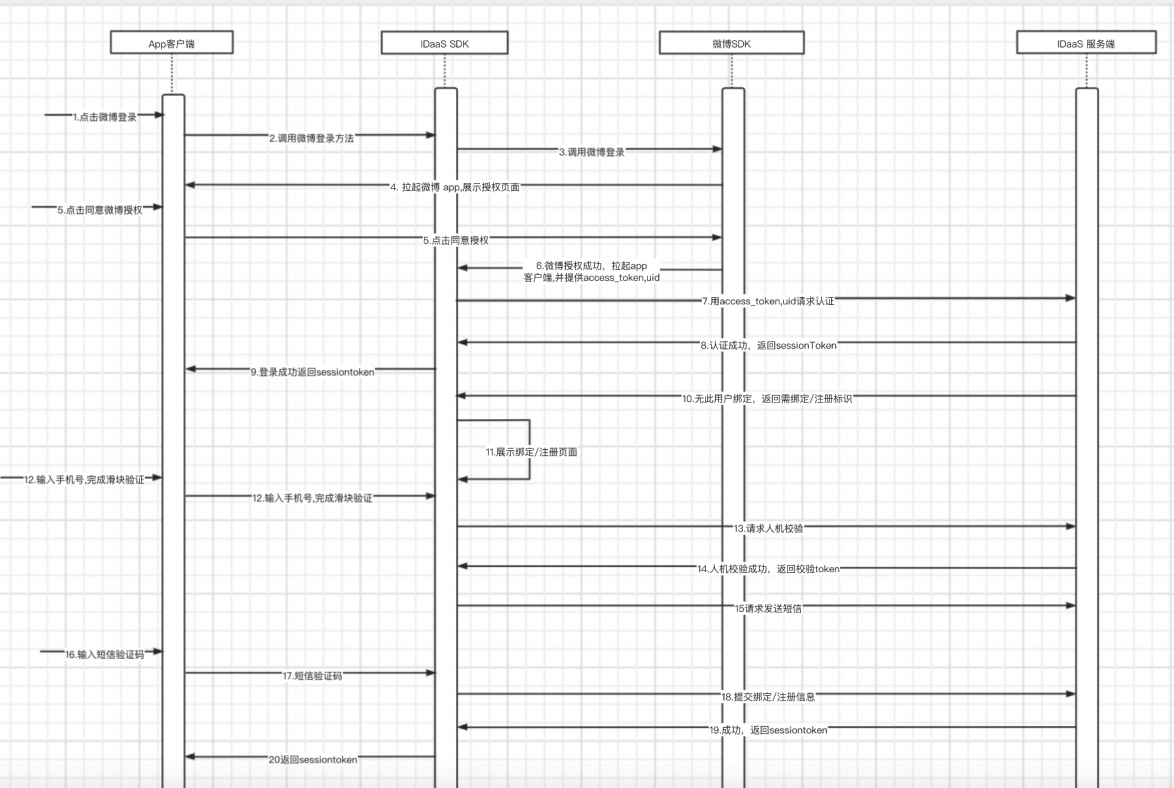
Integration Flow Description
The user clicks the Weibo login button on the APP client.
The APP client invokes the IDaaS SDK's Weibo login method.
The IDaaS SDK sends a login authorization request to the Weibo SDK.
The Weibo SDK launches the Weibo APP on the phone and displays the authorization login page.
The user clicks the authorize login button.
Weibo authorization is successful, launching the client APP and carrying the Weibo authorization credential
access tokenanduid. At this point, the IDaaS SDK automatically obtains the Weibo authorization credential during the launch.IDaaS uses the Weibo authorization credential to request authentication from the IDaaS server.
The IDaaS server checks if a phone number is bound. If a phone number is already bound, the IDaaS server authentication succeeds and returns a
sessionTokento the IDaaS SDK.The IDaaS SDK returns the
sessionTokento the APP client.If the IDaaS server finds that no phone number is bound, it returns an identifier indicating that binding or registration is required.
The IDaaS server displays the binding or registration page.
The user enters a phone number, clicks to get the verification code, and completes the slider verification.
The IDaaS SDK takes the slider verification code to the IDaaS server to request slider verification.
The IDaaS server successfully validates the slider and returns a
tokento the IDaaS SDK.The IDaaS SDK uses the
tokenand phone number to request the IDaaS server to send an SMS verification code.The user receives the SMS verification code, enters it into the input box, and clicks the bind or register button.
The IDaaS SDK submits the binding or login data to the IDaaS server.
Binding or registration is successful. The IDaaS server returns a
sessionTokento the IDaaS SDK.The IDaaS SDK returns the
sessionTokento the client APP.
# Preparations
Developers need to go to the Weibo Open Platform https://open.weibo.com/ (opens new window) to create their own development account, create a new application, and get it approved. Obtain the application's appID and appSecrete.
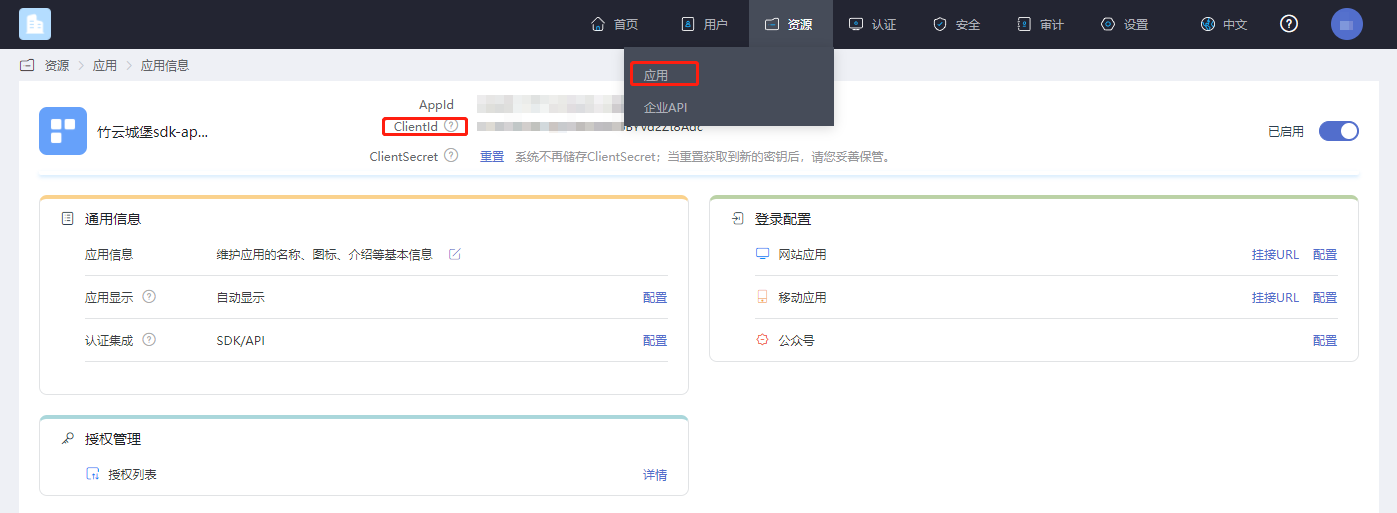
# Obtain Application clientID
Log in to the IDaaS Enterprise Center platform, click "Resources -> Applications", select the relevant application and click to view it.
# Configure Authentication Source
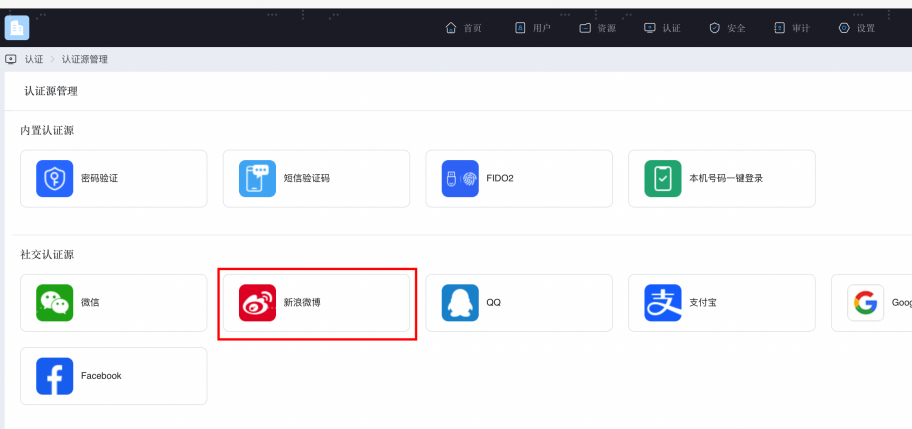
- Log in to the IDaaS Enterprise Center platform, click "Authentication -> Authentication Source Management -> Weibo".
- Click Add Authentication Source, fill in the
AppKeyandAppSecreteobtained after registering the application on the Weibo Open Platform. Select 'Mobile Application' in the channel selection box. Enter a name in the Display Name field.
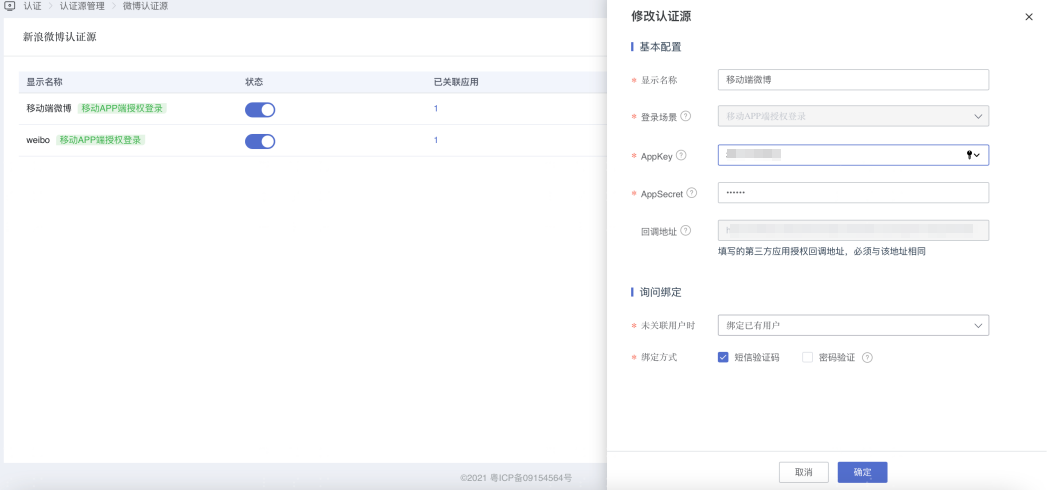
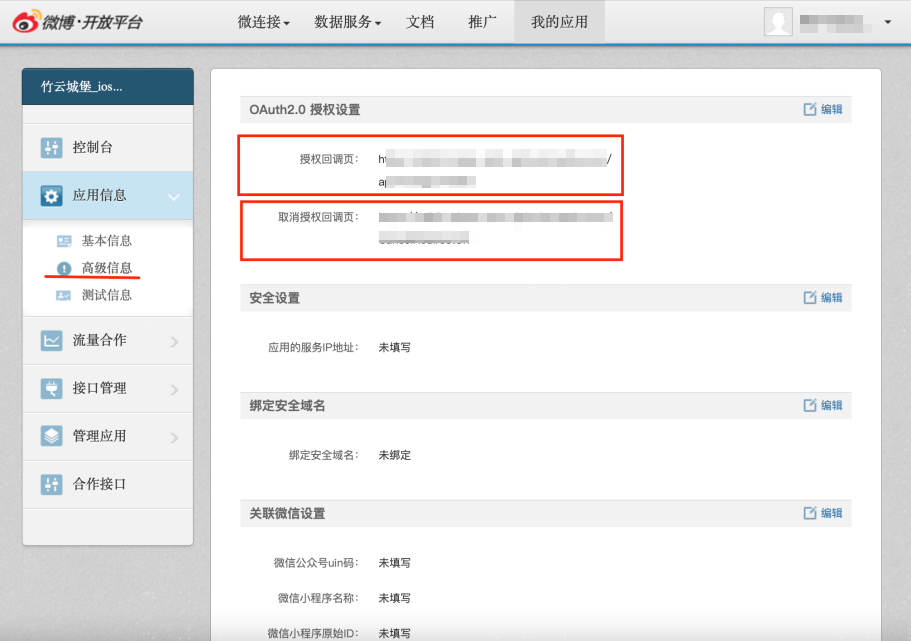
The callback address here needs to be filled in the advanced information of the application configuration on the Weibo Open Platform.
The authorization callback page here is as follows, which is also used as a redirectURI parameter required by the SDK: https://tenant.bccastle.com/api/v1/login/weibo
The deauthorization callback page is: https://tenant.bccastle.com/CancelRedirectUri
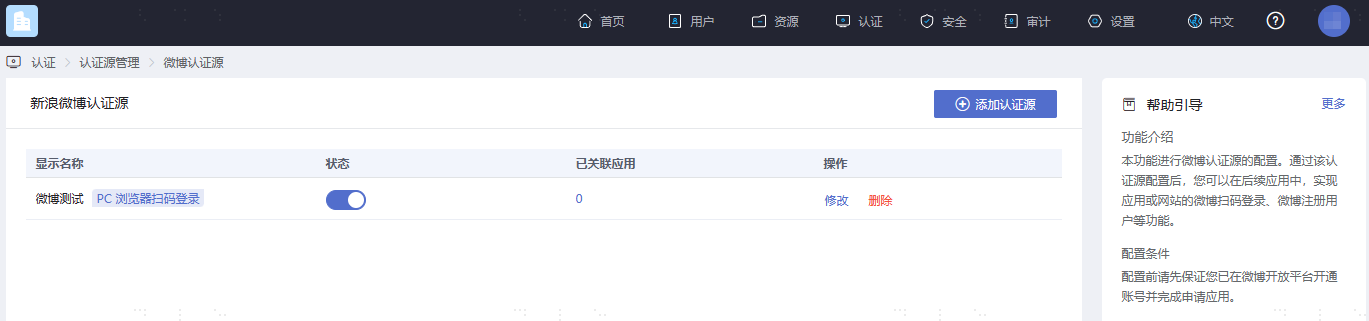
- Click OK, and you will get an authentication source as shown in the figure below.
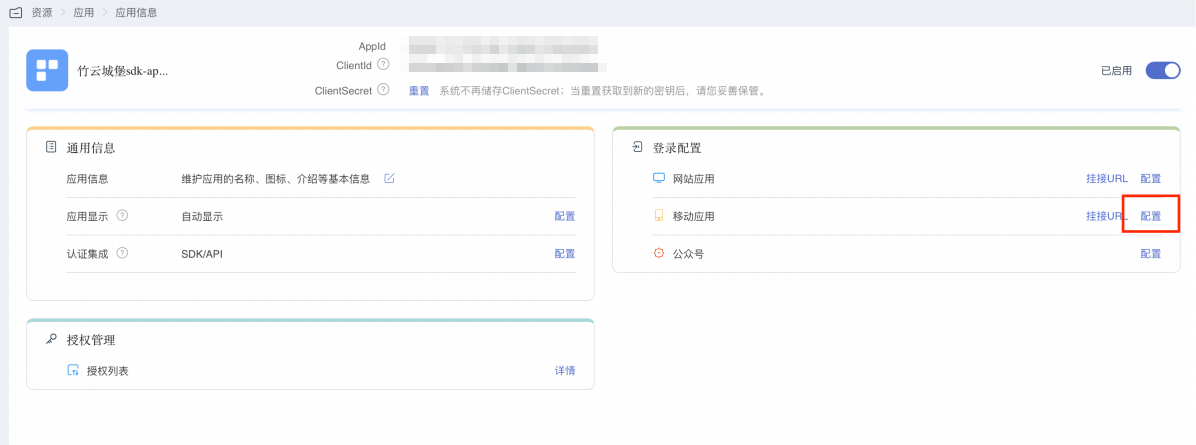
- Then go to Resources -> Applications, and click on the newly created App. After the application is created, go to Login Configuration -> Mobile Application -> Configuration.
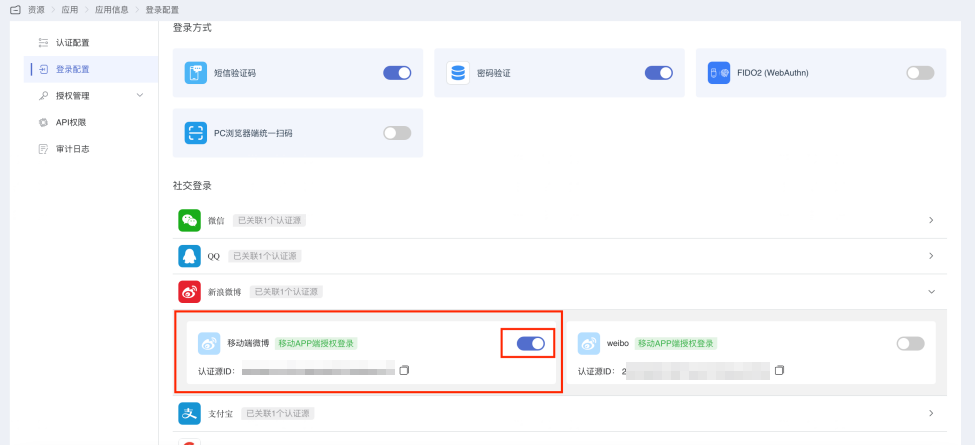
You will arrive at the window as shown below. Click the toggle button next to Weibo to turn it on.
# Import Dependency Packages
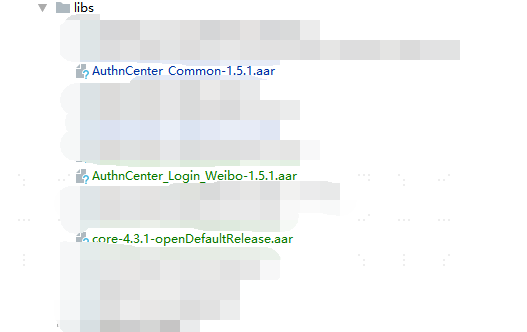
Import the aar package into lib, as shown in the figure below:
# Configure build.gradle
/*begin*/
/*  rxjava2 +  okhttp + retrofit2  */
api 'io.reactivex.rxjava2:rxjava:2.2.10'
api 'io.reactivex.rxjava2:rxandroid:2.1.1'
api 'com.squareup.retrofit2:retrofit:2.6.0'
api 'com.squareup.retrofit2:adapter-rxjava2:2.6.0'
api 'com.squareup.retrofit2:converter-gson:2.6.0'
api 'com.squareup.okhttp3:okhttp:4.3.1'
api 'com.squareup.okhttp3:logging-interceptor:3.6.0'
api 'com.jakewharton.retrofit:retrofit2-rxjava2-adapter:1.0.0'
api 'com.trello.rxlifecycle2:rxlifecycle-components:2.1.0'
api 'com.alibaba:fastjson:1.2.61'
 /*end*/

//Common library, required
implementation(name: 'AuthnCenter_Common-1.5.3', ext: 'aar')
//Weibo Login SDK, required
implementation(name: ''AuthnCenter_Login_Weibo-1.5.3', ext: 'aar')
//Official Weibo dependency library, required
implementation(name: 'core-4.3.1-openDefaultRelease', ext: 'jar')
2
3
4
5
6
7
8
9
10
11
12
13
14
15
16
17
18
19
20
# Configure AndroidManifest
  <!--Permissions-->
    <uses-permission android:name="android.permission.INTERNET" />
    <uses-permission android:name="android.permission.WRITE_EXTERNAL_STORAGE" />
    <uses-permission android:name="android.permission.READ_EXTERNAL_STORAGE" />
    <uses-permission android:name="android.permission.CAMERA" />
    <uses-permission android:name="android.permission.RECORD_AUDIO" />
    <uses-permission android:name="android.permission.READ_PHONE_STATE" />
    <uses-permission android:name="android.permission.MOUNT_UNMOUNT_FILESYSTEM"/>


        <!-- Country code interface, register as needed -->
        <activity
            android:name="com.authncenter.wechat.view.CountryCodeListActivity"
            android:launchMode="singleTask"
            android:screenOrientation="portrait" />
        <!-- SMS verification interface, register as needed -->
        <activity
            android:name="com.authncenter.loginweibo.view.MsgActivity"
            android:launchMode="singleTask"
            android:screenOrientation="portrait" />
2
3
4
5
6
7
8
9
10
11
12
13
14
15
16
17
18
19
20
# Development Integration
# Built-in API Introduction
Basic configuration initialization main class AuthnCenterAPI method introduction:
/**
 * SMS verification code -- Send SMS
 */
public void smsSend(Context context, SendSmsReq req, RequestListener listener)

/**
 * Get country code    Note: If country codes are configured, this interface must be called to obtain the country code
 */
public void getCountryCode(Context context, RequestListener listener)

/**
 * Social account binding interface
 * @param context      Context
 * @param stateToken   Temporary token returned after current login
 * @param otpsmsReq    Binding object information
 * @param listener     Event callback
 */
public void socialBind(Context context, String stateToken, OTPSMSReq otpsmsReq, RequestListener listener)

/**
 *  Register
 * @param context      Context
 * @param stateToken   Temporary token returned after current login
 * @param otpsmsReq    Registration object information
 * @param listener     Event callback
 */
public void register(Context context, String stateToken, OTPSMSReq otpsmsReq, RequestListener listener)
2
3
4
5
6
7
8
9
10
11
12
13
14
15
16
17
18
19
20
21
22
23
24
25
26
27
Weibo login initialization main class AuthnCenterLoginWeibo method introduction:
/**
 *   Weibo login
 * @param context  Context
 * @param loginListener Event listener
 * @param loginType      LoginType.DEFAULT (Built-in), LoginType.CUSTOM (Custom)
 */
public void loginByWeiBo(Context context, WeiboLoginListener loginListener, LoginType loginType)
2
3
4
5
6
7
8
# Mobile International Dialing Code Retrieval
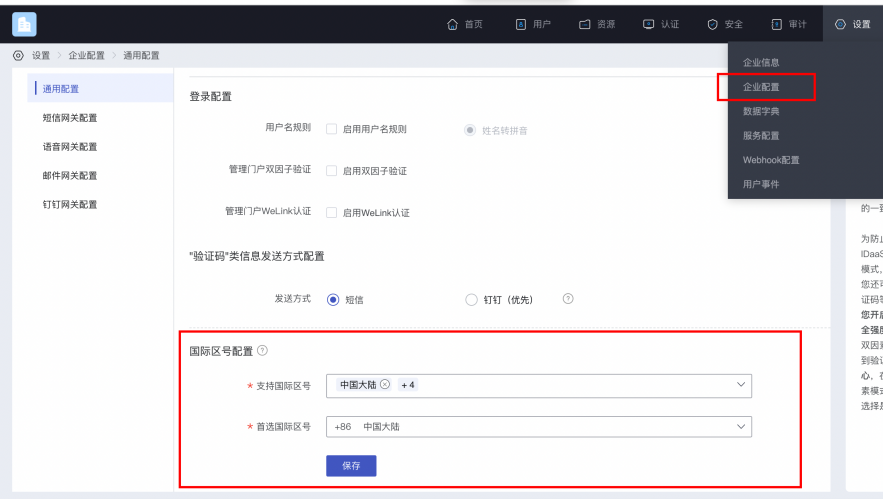
If international phone number support is enabled, please first call the international dialing code retrieval interface. The international dialing code retrieval interface returns the configured list of international dialing codes, along with regular expressions for phone numbers. The image below shows how to configure the international dialing code list and the preferred dialing code.
Example code for retrieving the international dialing code list:
AuthnCenterAPI.Builder().getCountryCode(this, new RequestListener<CountryCodeInfoRsp>() {
    @Override
    public void success(CountryCodeInfoRsp codeInfoRsp) {

    }

    @Override
    public void error(String code, String errorMessage) {
    }
});
2
3
4
5
6
7
8
9
10
Successful example code=0, data value:
{
	"phoneAreaCodeDefinitions": [
		{
			"areaCode": "86",
			"displayMapping": {
				"zh-TW": "中國大陸",
				"en": "China",
				"zh-CN": "中国大陆"
			},
			"countryCode": "CN",
			"mobileRegex": "^(\\+86){0,1}\\-?1\\d{10}$",
			"areaCodeSuffixes": []
		},
		{
			"areaCode": "852",
			"displayMapping": {
				"zh-TW": "中國香港",
				"en": "Hong Kong",
				"zh-CN": "中国香港"
			},
			"countryCode": "HK",
			"mobileRegex": "^(\\+852){1}\\-?0{0,1}[1,4,5,6,7,8,9](?:\\d{7}|\\d{8}|\\d{12})$",
			"areaCodeSuffixes": []
		},
		{
			"areaCode": "886",
			"displayMapping": {
				"zh-TW": "中國臺灣",
				"en": "Taiwan",
				"zh-CN": "中国台湾"
			},
			"countryCode": "TW",
			"mobileRegex": "^(\\+886){1}\\-?[6,7,9](?:\\d{7}|\\d{8})$",
			"areaCodeSuffixes": []
		},
		{
			"areaCode": "853",
			"displayMapping": {
				"zh-TW": "中國澳門",
				"en": "Macau",
				"zh-CN": "中国澳门"
			},
			"countryCode": "MO",
			"mobileRegex": "^(\\+853){1}\\-?0{0,1}[1,4,5,6,7,8,9](?:\\d{7}|\\d{8}|\\d{12})$",
			"areaCodeSuffixes": []
		},
		{
			"areaCode": "93",
			"displayMapping": {
				"zh-TW": "阿富汗",
				"en": "Afghanistan",
				"zh-CN": "阿富汗"
			},
			"countryCode": "AF",
			"mobileRegex": "^(\\+93){1}\\-\\d{6,11}",
			"areaCodeSuffixes": []
		}
	],
	"preferredAreaCode": "CN"
}
2
3
4
5
6
7
8
9
10
11
12
13
14
15
16
17
18
19
20
21
22
23
24
25
26
27
28
29
30
31
32
33
34
35
36
37
38
39
40
41
42
43
44
45
46
47
48
49
50
51
52
53
54
55
56
57
58
59
60
Return Parameters:
| Parameter Name | Chinese Name | Type | Description |
|---|---|---|---|
| preferredAreaCode | Preferred International Dialing Code | String | The preferred international dialing code configured for the current enterprise center. |
| countryCode | Country/Region Code | String | Country/Region Code |
| areaCode | International Telephone Dialing Code | String | International Telephone Dialing Code |
| areaCodeSuffixes | International Telephone Dialing Code Suffix | String | International Telephone Dialing Code Suffix |
| mobileRegex | Mobile Number Format Regex | String | Mobile Number Format Regex |
| displayMapping | Multi-language Display Name Mapping | String | Multi-language Display Name Mapping |
# Built-in Sliding Verification {/内置滑动校验/}
Human-machine interaction verification is required when sending verification codes.
BlockPuzzleDialog mBlockPuzzleDialog = new BlockPuzzleDialog(mContext);
mBlockPuzzleDialog.setOnResultsListener(new OnResultsListener() {
        @Override
        public void onResultsClick(String result) {
            LogUtil.getInstance().d("Secondary verification callback result mCaptchaToken:" + result);
            // This callback result is the captchaToken parameter for SMS verification.
        }
        @Override
        public void onError(String code, String msg) {
            ToastUtils.ShowToast(mContext, String.format("Error Code: %s  Error Message: %s", code, msg));
        }
    });
}
2
3
4
5
6
7
8
9
10
11
12
13
14
# Sending Verification Code
The App client needs to have its own UI interface, which should include several essential components: a phone number input field, a verification code input field, a button (or event) to trigger obtaining the verification code, and a login button (or event).
After the user enters a phone number and before clicking (triggering) the send verification code event, the App client should perform phone number format validation.
When the send verification code event is clicked (triggered), the App client calls the IDaaS SDK's method to send the verification code. An example is as follows:
//Send verification code
SendSmsReq sendSmsReq = new SendSmsReq();
sendSmsReq.setMobile(getPhoneNum());
sendSmsReq.setType(SendSmsType.login);//Type enumeration
sendSmsReq.setCaptcha_token("The result returned after successful sliding captcha verification");
AuthnCenterAPI.Builder().smsSend(mContext, sendSmsReq
        , new RequestListener<BaseResponse>() {
            @Override
            public void success(BaseResponse rsp) {
            }
            @Override
            public void error(String code, String errorMessage) {
            }
        });
2
3
4
5
6
7
8
9
10
11
12
13
14
# Built-in UI Development Integration
# Initialization
AuthnCenterSDK.Builder()
                .init(this)
                .setBaseUrl("https://xxx.xxx.com")      //Tenant domain name
                .setClientId("xxxx") //Application client-id from the tenant backend
                .isCheckSSL(false) //Whether to check SSL certificate
                .logEnable(false).build(); //Whether to enable HTTP request logging
PlatformConfig.Builder().init(this).setWeiBoAppId("XXXX"); //Set Weibo APPID
PlatformConfig.Builder().init(this).setWeiBoRedirectUrl("XXX"); //Set Weibo Open Platform callback URL
2
3
4
5
6
7
8
# UI Customization
The caller can set the text, descriptions, colors, etc., of the binding interface via BindThemeConfig. Specific attributes are as follows:
//Customize interface
BindThemeConfig.Builder().setBindTitle("I am the title")
        .setBindDes("I am the details")
        .setBindButtonText("I just want to change the button text")
        .setBindButtonTextDefaultColor("#367517")
        .setBindButtonTextColor("#C8E2B1")
        .setBindButtonTextOnPressColor("#F9F400")
        .setSendMsgColor("#976D00")
        .setSendMsgNoActiviColor("#50A625")
        .setDialogTitle("I just want to customize")
        .setDialogBtnConfirmColor("#FFB6C1");
2
3
4
5
6
7
8
9
10
11
# Attribute Description
| Parameter | Type | Description | Example |
|---|---|---|---|
| setBackFont | String | Change the back text | N/A |
| setBackFontColor | String | Change the back text color | Hexadecimal color, e.g., #FFFFFF |
| setBackImg | int | Set the back icon | Resource file R |
| setBackFontSize | int | Set the back text size | 14sp |
| setCountryCodeVisibility | boolean | Set whether to display the international dialing code | Default is true |
| setBindTitle | String | Binding interface title | N/A |
| setBindDes | String | Binding interface description | N/A |
| setBindButtonText | String | Binding button text | N/A |
| setBindButtonTextDefaultColor | String | Binding button text default background color | Hexadecimal color, e.g., #FFFFFF |
| setBindButtonTextColor | String | Binding button text color | Hexadecimal color, e.g., #FFFFFF |
| setBindButtonTextOnPressColor | String | Binding button text background color after being pressed | Hexadecimal color, e.g., #FFFFFF |
| setSendMsgColor | String | Send SMS button text color | Hexadecimal color, e.g., #FFFFFF |
| setSendMsgNoActiviColor | String | Countdown text color | Hexadecimal color, e.g., #FFFFFF |
| setDialogTitle | String | Unbind popup dialog title | N/A |
| setDialogBtnConfirmColor | String | Unbind popup dialog confirm button color | Hexadecimal color, e.g., #FFFFFF |
| sendMsgNoActiveBackground | int | Send SMS button background resource | Android color or background resource file (R) |
| setButtonBackground | int | Send SMS button default background resource | Android color or background resource file (R) |
| setSendMsgBackground | int | Binding button background resource | Android color or background resource file (R) |
# Weibo Login Built-in Interface
AuthnCenterLoginWeibo.Builder().loginByWeiBo(this, new WeiboLoginListener() {
    @Override
    public void success(String code, String data) {
  //Success callback
    }
    @Override
    public void error(String code, String errorMessage) {
//Failure callback
    }
}, LoginType.DEFAULT);
2
3
4
5
6
7
8
9
10
# Integration via API Development
If you choose this integration method, after the login returns, you need to handle the binding or registration business and perform basic operations related to phone number verification yourself based on the returned status.
Also, the relevant registration information in the AndroidManifest file can be filled in with your own.
# Call Sequence Description
After a successful login, if the returned status is binding, then you need to call:
Get country code (call this based on whether internationalization support is configured) (getCountryCode)
Slide verification (BlockPuzzleDialog)
Send SMS (smsSend)
Bind or register (socialBind/register)
# Initialization
AuthnCenterSDK.Builder()
                .init(this)
                .setBaseUrl("https://xxx.xxx.com")      //Tenant domain name
                .addGlobalHeader("X-client-id", "xxxx") //Tenant backend application client-id
                .isCheckSSL(false) //Whether to check SSL certificate
                .logEnable(false).build(); //Whether to enable HTTP request logs
PlatformConfig.Builder().init(this).setWeiBoAppId("XXXX"); //Set Weibo APPID
PlatformConfig.Builder().init(this).setWeiBoRedirectUrl("XXX"); //Set Weibo Open Platform callback URL
2
3
4
5
6
7
8
# Weibo Login (Custom Interface)
AuthnCenterLoginWeibo.Builder().loginByWeiBo(this, new WeiboLoginListener() {
    @Override
    public void success(String code, String data) {
//Based on the code return value here, navigate to your own interface to perform binding or registration operations.
        Intent intent = new Intent(MainActivity.this, WeiBoActivity.class);
        intent.putExtra(SocialType.STATETOKEN, data);
        intent.putExtra(SocialType.BINDTYPE, SocialType.WX);
        switch (code) {
   case "10002":   //Login successful
ToastUtils.ShowToast(MainActivity.this, "Login successful : " + data);
                return;
            case "10003":   //Bind user
               intent.putExtra(SocialType.ACTIONTYPE, ActionType.BIND);
                break;
            case "10004": //Register user
                intent.putExtra(SocialType.ACTIONTYPE, ActionType.REGISTER);
                break;
        }
        intent.setFlags(Intent.FLAG_ACTIVITY_NEW_TASK);
        startActivity(intent);
    }

    @Override
    public void error(String code, String errorMessage) {
        ToastUtils.ShowToast(MainActivity.this, "SDK callback code : " + code + "---- msg " + errorMessage);
    }
}, LoginType.CUSTOM);
2
3
4
5
6
7
8
9
10
11
12
13
14
15
16
17
18
19
20
21
22
23
24
25
26
27
Here, judgment is made based on the returned code:
| Code | Description |
|---|---|
| 10001 | AuthCenter server error |
| 10002 | Success |
| 10003 | User binding required |
| 10004 | User registration required |
# Return Codes
| Status Code | Error Code (error_code) | Error Description (error_msg) | Action |
|---|---|---|---|
| 400 | IDAAS.SDK.COMMON.1001 | Parameter {0} cannot be left blank | |
| Parameter {0} cannot be empty | |||
| 400 | IDAAS.SDK.COMMON.1002 | The {0} parameter format is incorrect | |
| Parameter {0} format error | |||
| 400 | IDAAS.SDK.COMMON.1003 | Device information is incomplete | |
| Incomplete device information | |||
| 400 | IDAAS.SDK.COMMON.1004 | Signature decryption error | |
| Signature decryption error | |||
| 400 | IDAAS.SDK.COMMON.1005 | The {0} has failed | |
| {0} has expired | |||
| 400 | IDAAS.SDK.COMMON.1006 | The {0} parameter error | |
| {0} parameter error | |||
| 400 | IDAAS.SDK.COMMON.1007 | The {0} parameter type error | |
| {0} parameter type error | |||
| 500 | IDAAS.SDK.COMMON.1008 | The system is busy. Try again later | |
| System busy. Please try again later | |||
| 400 | IDAAS.SDK.COMMON.1009 | Unknown authentication configuration | |
| Unknown authentication configuration | |||
| 400 | IDAAS.SDK.COMMON.1010 | Failed to obtain the enterprise center global configuration | |
| Failed to obtain enterprise center global configuration | |||
| 400 | IDAAS.SDK.COMMON.1011 | Failed to obtain the international area code configuration | |
| Failed to obtain international area code configuration | |||
| 400 | IDAAS.SDK.COMMON.1012 | The x-client-ID is incorrect and the corresponding application cannot be found | |
| X-client-id error, corresponding application not found | |||
| 400 | IDAAS.SDK.COMMON.1013 | The corresponding user is not found | |
| Corresponding user not found | |||
| 400 | IDAAS.SDK.COMMON.1014 | Application private key not found | |
| Application private key not found | |||
| 400 | IDAAS.SDK.LOGIN.1001 | Error calling interface {0} | |
| Error calling interface {0} | |||
| 400 | IDAAS.SDK.LOGIN.1002 | User not bound | |
| User not bound | |||
| 400 | IDAAS.SDK.LOGIN.1003 | The user has been locked due to too many unsuccessful login attempts. It will be unlocked in {0} minutes and {1} seconds | |
| The user has been locked due to too many unsuccessful login attempts. It will be unlocked in {0} minutes and {1} seconds | |||
| 400 | IDAAS.SDK.LOGIN.1004 | Failed to obtain the password policy | |
| Failed to obtain password policy error | |||
| 400 | IDAAS.SDK.LOGIN.1005 | Invalid username or password. Remaining login attempts: {0} | |
| Invalid username or password. Remaining login attempts: {0} | |||
| 400 | IDAAS.SDK.LOGIN.1006 | Configuration error, unable to find wechat authentication source | |
| Configuration error, unable to find WeChat authentication source | |||
| 400 | IDAAS.SDK.LOGIN.1007 | Configuration error, unable to find alipay authentication source | |
| Configuration error, unable to find Alipay authentication source | |||
| 400 | IDAAS.SDK.LOGIN.1008 | The configuration is incorrect. The one-click login authentication source cannot be found | |
| Configuration error, unable to find one-click login authentication source | |||
| 400 | IDAAS.SDK.SMS.1001 | {0} slide base map is not initialized successfully, please check the path | |
| {0} slide base map not initialized successfully, please check the path | |||
| 400 | IDAAS.SDK.SMS.1002 | {0} verification code coordinate resolution failed | |
| {0} verification code coordinate resolution failed | |||
| 400 | IDAAS.SDK.SMS.1003 | {0} verification code coordinate verification fails | |
| {0} verification code coordinate verification fails | |||
| 400 | IDAAS.SDK.SMS.1004 | The graphic verification code is incorrect | |
| Graphic verification code verification error | |||
| 400 | IDAAS.SDK.SMS.1005 | SMS verification code verification is incorrect | |
| SMS verification code verification error | |||
| 400 | IDAAS.SDK.SMS.1006 | The email verification code is incorrect | |
| Email verification code verification error | |||
| 400 | IDAAS.SDK.SMS.1007 | Sending scenario does not exist | |
| Sending scenario does not exist | |||
| 400 | IDAAS.SDK.SMS.1008 | Failed to send the verification code | |
| Failed to send verification code | |||
| 400 | IDAAS.SDK.SOCIAL.1001 | The social account is unbound incorrectly | |
| Social account unbinding error | |||
| 400 | IDAAS.SDK.SOCIAL.1002 | The social account has been bound, please unbind it first | |
| Social account already bound, please unbind first | |||
| 400 | IDAAS.SDK.PWD.1001 | The password length is incorrect | |
| Password length error | |||
| 400 | IDAAS.SDK.PWD.1002 | The password cannot be the username | |
| Password cannot be username | |||
| 400 | IDAAS.SDK.PWD.1003 | Your password complexity is low | |
| Your password complexity is low | |||
| 400 | IDAAS.SDK.PWD.1004 | The password is weak | |
| Password is weak | |||
| 400 | IDAAS.SDK.PWD.1005 | The password is used before, cannot be used again | |
| This password has been used before and cannot be used again | |||
| 400 | IDAAS.SDK.PWD.1006 | Password cannot username in reverse order | |
| Password cannot be username in reverse order | |||
| 400 | IDAAS.SDK.PWD.1007 | The number of repeated password characters exceeded the upper limit | |
| Number of repeated password characters exceeds limit | |||
| 400 | IDAAS.SDK.PWD.1008 | Password cannot contain :username, phone number, email prefix, name in PinYing | |
| Password cannot contain: username, phone number, email prefix, name in Pinyin | |||
| 400 | IDAAS.SDK.MFA.1001 | The mobile doesn't match the user | |
| Phone number does not match user | |||
| 400 | IDAAS.SDK.MFA.1002 | The access control policy is incorrect | |
| Access control policy configuration error | |||
| 400 | IDAAS.SDK.MFA.1003 | Access control authentication source type conversion error | |
| Access control authentication source type conversion error |
Please provide the Markdown content you would like me to translate.